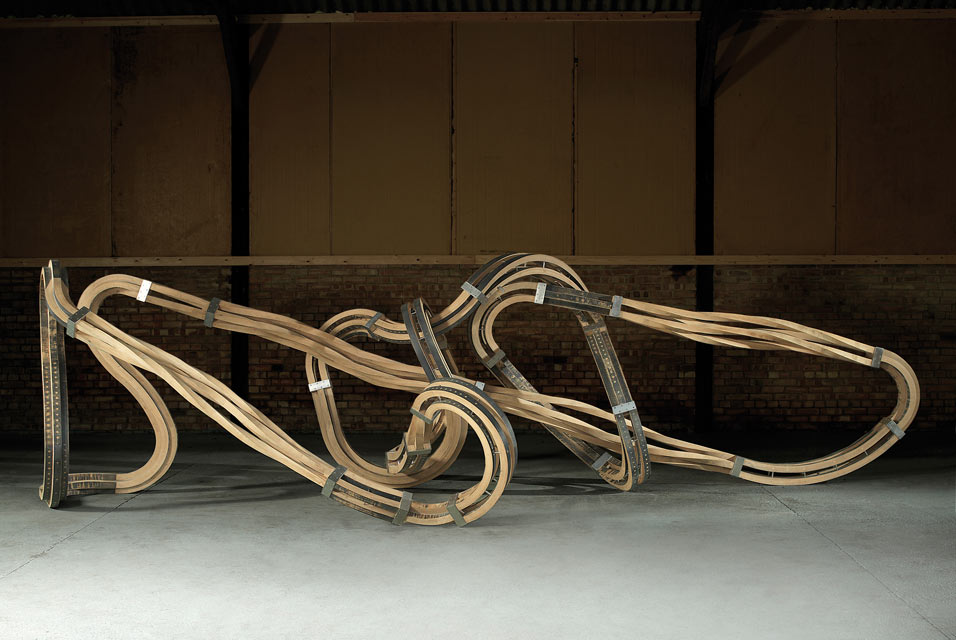
Richard Deacon
Richard Deacon is a British sculptor who works with wood and metals primarily, but also uses plastics, fiberglass, and ceramics. His work has a similar style to that of Martin Puryear. All of the images I am posting are from his website.

He works with the bent lamination technique on a typically large scale. Here is a shot that is not from his site, but just shows the process of bending the wood. The wood is bent along the grain. Typically, several rip-cut strips are laid one atop the other and clamped into a
  jig that forces the wood into a particular shape.
This piece on the left is made out of galvanized steel and concrete, but the style and joinery of materials is treated similarly to wood joinery. You can see the finger or dovetail-like joints around the larger opening. Although the materials differ, he seems to conform them into a similar expression.


He says his work is not about technique. It is more about the ability to form materials, seemingly contrary to their nature. It is a primal act of manipulating the materials around us. Technique is of course inherent in the extent of his manipulation, but is not what he would say is the essence of it.
But look at this crazy thing.
 It is hard to look at this thing and not be overwhelmed with the question, "How the hell did he do that?" I would imagine that even to the expert who knows how he made it, the detail and complexity seems to be the emphasis of this piece. To me, it seems to be all about technique. I go back and forth on how necessary titles are. His titles vary from very sterile to sort of emotional, while the aesthetic pretty much remains constant.
It is hard to separate him from Martin Puryear. Not only in the similar methods/style of working, but they are both craftsmen and artists. There work represents them as both. Some work is craft, some work is art. They seem to strattle the two realms rather successfully. Here is another really crazy awesome piece that had some fabrication shots on the website.

 These are detail shots of the craziness. You can see the braces he uses to keep it together. Now for the really cool part. Check out these elaborate set ups. This guys is really prolific too. If you check out his website, it goes back to the 1980s. He has so much work.
He works with the bent lamination technique on a typically large scale. Here is a shot that is not from his site, but just shows the
process of bending the wood. The wood is bent along the grain. Typically, several rip-cut strips are laid one atop the other and clamped into a jig that forces the wood into a particular shape.This piece on the left is made out of galvanized steel and concrete, but the style and joinery of materials is treated similarly to wood joinery. You can see the finger or dovetail-like joints around the larger opening. Although the materials differ, he seems to conform them into a similar expression.
He says his work is not about technique. It is more about the ability to form materials, seemingly contrary to their nature. It is a primal act of manipulating the materials around us. Technique is of course inherent in the extent of his manipulation, but is not what he would say is the essence of it.
But look at this crazy thing.
It is hard to look at this thing and not be overwhelmed with the question, "How the hell did he do that?" I would imagine that even to the expert who knows how he made it, the detail and complexity seems to be the emphasis of this piece. To me, it seems to be all about technique. I go back and forth on how necessary titles are. His titles vary from very sterile to sort of emotional, while the aesthetic pretty much remains constant.It is hard to separate him from Martin Puryear. Not only in the similar methods/style of working, but they are both craftsmen and artists. There work represents them as both. Some work is craft, some work is art.
They seem to strattle the two realms rather successfully. Here is another really crazy awesome piece that had some fabrication shots on the website. These are detail shots of the craziness. You can see the braces he uses to keep it together. Now for the really cool part. Check out these elaborate set ups. This guys is really prolific too. If you check out his website, it goes back to the 1980s. He has so much work.